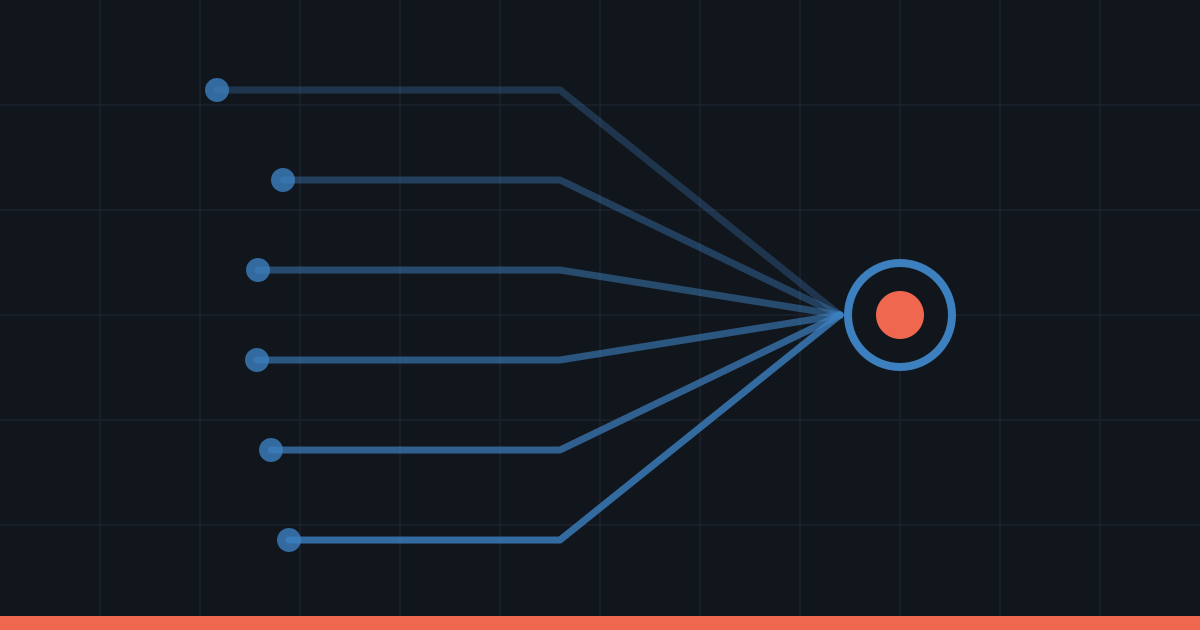
An AI revenue system is mostly ordinary plumbing. Capture, deduplication, routing rules, and ownership are deterministic CRM configuration that vendors have shipped for years. The AI occupies a few narrow slots: inferring fit, ranking intent, and drafting a first message. Get the plumbing wrong and the model routes bad records faster.
What does an AI revenue system actually do to a lead?
It runs a record through six stages, and only two of them involve a model.
A form submission arrives. The system captures it, resolves it against records that already exist, enriches it with data the form did not ask for, scores it, routes it to an owner, and hands it to a person. Marketing decks compress all six into one word. Operations does not have that luxury, because each stage fails differently and each one has a different owner.
The stages that decide whether the system works are the boring ones. Capture is a form and a webhook. Resolution is duplicate matching. Routing is a sorted list of conditions. None of that is intelligence. All of it is configuration, and it is where the money leaks.
Where the plumbing actually lives
Look at what the CRM vendors document, because the documented primitives are the system.
Salesforce's Metadata API describes an assignment rule as a container of rule entries. Each entry carries its criteria items (the conditions), an assignedTo value (the name of the user or queue), and an assignedToType whose valid values are User or Queue. Entries are processed in the order they appear. That is the whole of lead routing at the platform level: an ordered list of conditions, each pointing at a person or a bucket. There is no model in it.
Deduplication has the same shape. Salesforce pairs matching rules (how to compare records) with duplicate rules (what to do when a match is found), and the documented limits are concrete: up to three matching rules in each duplicate rule, and up to five active matching rules per object. Those numbers are the actual ceiling on how cleverly a company can decide that two inbound records are the same human.
Scoring is a third piece of configuration. HubSpot's documentation splits scores into fit (property values such as job title, company size, or annual revenue) and engagement (actions such as opening an email or clicking a CTA), plus a combined score. Thresholds label a record from A to C on fit and 1 to 3 on engagement, so in HubSpot's own example, "a low-fit but highly engaged contact would have a value of C1." HubSpot also notes that when a score is updated, "property values and actions are re-evaluated retroactively based on the changes you've made."
Read that last one twice. Change the scoring model and yesterday's leads quietly get new grades. Any report comparing this quarter's A-leads to last quarter's is comparing two different definitions unless somebody wrote the change down.
So what is the AI actually doing?
Three things, in practice, and they are narrower than the category name suggests. It infers attributes the form did not collect, such as guessing segment from an email domain. It ranks intent, replacing a hand-tuned point table with a fitted one. And it drafts the first human-sounding message.
Notice what is not on that list. The model does not decide who owns the account. It does not decide whether two records are one person. It does not decide what happens when nobody responds in four hours. Those are policy. Policy is written by people and enforced by rules.
Practitioners enforce that line in public. On a shared skills repository, a contributor proposed a product-qualified lead framework: a scoring and routing system with pre-scoring filters, a weighted matrix, decay logic, and A/B/C tiering. It was opened on June 18, 2026 and closed on July 3, 2026 by the maintainer, farizanjum, with a one-line verdict: "The pql-framework skill is a methodology guide, not an actionable skill." The stated problem was that it shipped no actual scoring automation and no integrations, only advice a model could already generate on its own.
That is the category compressed into a code review. A scoring philosophy is free. A scoring system is the integration.
The speed problem is a routing problem, and it predates the AI
The most-quoted number in this field deserves careful handling, because it is old and vendor-published, and both facts are informative rather than disqualifying.
In an executive summary presented at MarketingSherpa's Business-to-Business Demand Generation Summit on October 16, 2007, Dave Elkington of the vendor InsideSales and Dr. James Oldroyd, then a faculty fellow at MIT, reported: "The odds of contacting a lead if called in 5 minutes versus 30 minutes drop 100 times. The odds of qualifying a lead if called in 5 minutes versus 30 minutes drop 21 times."
Three caveats belong with that quote, and all three come from the document itself. The paper is copyright InsideSales, and page 6 states plainly that "This study caused a significant shift in our corporate positioning," going on to describe the company's web-form callback dialer. The vendor sold the remedy its own finding recommends. Oldroyd added a limit of his own: he "finds these clear patterns in the data only when data from several companies is combined together," which is a caution against reading the multiple as a promise for any single company. And the companion Kellogg survey of 495 companies failed to answer the question at all. The authors wrote that they "couldn't find ANY statistically significant answers to our question of WHEN."
So cite it as what it is: a dated, vendor-copublished study whose direction has held up better than its magnitude.
The durable insight in that 2007 paper is not the multiple anyway. It is a sentence near the end: "We learned that a request for a price quote needs to be handled different than a whitepaper." Route by intent, not by arrival order. That was true before anyone put a model on it, and it is still the design instruction.
And notice what actually closes the gap between a five-minute response and a thirty-minute one. Not a smarter model. A webhook that fires on submit, a rule that resolves an owner without a human in the loop, and a defined fallback when that owner is unavailable. Latency is a plumbing property.
What to build, and in what order
The order below is deliberately unexciting.
- Define the owner for every lead type before writing a single rule. If two people can each plausibly claim a record, no routing engine will settle it.
- Fix identity resolution next. A scored duplicate is two half-scores.
- Write the routing rules as an ordered list and read them top to bottom, the way the platform will.
- Define the fallback. Most routing bugs are not misroutes. They are leads assigned to someone on vacation.
- Instrument the handoff. Log when the lead arrived, when it was assigned, and when a human first touched it.
- Only then fit a model to the scoring step, because only now do you have labels. Steps 1 through 5 are CRM hygiene. They are what a company would do to route leads with no AI involved at all. That is the point. The model in step 6 trains on the exhaust from steps 1 through 5, so a company that skips them has nothing to train on and no way to tell whether the resulting score means anything.
This is a different failure from the one described in what AI agents actually break on in a real back office, which is about not being able to see what an agent did. This one sits upstream. Here the system is perfectly observable and the definitions underneath it are wrong, so it reports confidently on a fiction. It is the same disease as an executive dashboard that fails before the data arrives: the number renders, and it is not defensible.
Commerce Beacon builds AI sales funnel systems in that order, plumbing first. Capture, identity, ownership, and the handoff are the product. The model is a component inside it, sitting in the two or three places where ranking genuinely beats a point table. A company that cannot say who owns an inbound lead does not have a scoring problem. It has an org chart problem, and no model will read the org chart for them.